A journey through Krimiland. Read all about the Teutonic fascination with Edgar Wallace, Bryan Edgar Wallace, Dr Mabuse, Jerry Cotton, Kommissar X, Father Brown or even Louis-Weinert Wilton and discover a world of hidden vaults, madmen in masks and bumbling butlers.
The Thousand and One Lives of Doctor Mabuse is not exactly a standalone film but anyone with a passing knowledge of previous Mabuse movies or the novels by Norbert Jacques should have no problem getting into it. I have yet to see his first two entries but what I like about this production is that it manages to create a unique world within the Mabuse myth that may of course contain some references to previous incarnations but otherwise goes its very own way.
Just goes to show that low budget should never stop you from fulfilling your visions.
Also impressive to see that within that trilogy Ansel incorporated elements of Etiopomar, the fictitious country Mabuse was planning to set up and rule in the original novels, an element of the plot that was never much highlighted in earlier adaptations.
Say what you want about streaming services but every once in a while you can come across some truly obscure nuggets.
Case in point German/Italian co-production Serenade für zwei Spione/Serenade for Two Spies (1965) - with Helmut Lange in the lead role - that I found featured on Prime (here in Ireland but probably also available elsewhere).
Directed by Michael Pfleghar - who would later on revolutionise (and sex up!) German TV comedy with his truly anarchic series Klimbim featuring Ingrid Steeger amongst an ensemble cast -, this is an entertaining but uneven mix that never quite seems to know if it wants to be a James Bond clone or a genuine parody of the genre. In the end the heavy handed but often deeply absurd comedic elements win over which is a pity as the stunning location photography in San Francisco, Las Vegas and the surrounding desert would have made an excellent choice for a more serious Eurospy contender.
When the prototype for a new revolutionary laser gun goes missing, the FBI sends Agent Cormoran (Mimmo Palmara) out to retrieve it, however, it soon appears that he may have defected himself. The Secret Service (it is never quite clear to me whether it’s supposed to be the British or the German one) sends out Agent John Krim (Krim, Krimi, geddit?) to retrieve the prototype and eliminate the Cormoran if necessary.
As he doesn’t like the idea of flying, he just water skis over the Atlantic and starts a madcap search for rifle and FBI agent. (Later on in the film by the way he seems to have forgotten about that when he lands a small plane on a strip in the middle of Las Vegas, a scene for which the production team never bothered to get an official permit. Instead they had just paid off some local cops on the beat to monitor the scene for safety and else keep shtumm about it.)
The film is chockablock with so many James Bond references that it’s a wonder EON or the Fleming Estate didn’t sue.
Bond gets straight out name checked repeatedly.
In the German version Lange’s character is even given the code name 006 and is described as the department’s second best agent next to Bond who is currently on another mission. (In the English version it is 006 1/2).
We even have the briefest of Goldfinger musical cues at some stage.
Hellmut Lange always made a good rugged looking hero in numerous TV adventure series. His interpretation as James Fenimore Cooper’s “Leatherstocking” was one of my childhood favourites. He also hosted a popular cinema related quiz show on television and as a dubbing actor had a distinguished voice that could be heard in many international productions. He also was one of the leads in Rialto’s Der Fälscher von London/The Forger of London (1961).
As a comedic actor, however, he was severely miscast and oddly stiff looking. Exploding toilets, flirtatious ladies and off-the-cuff one-liners just weren’t his forte.
Worst of all, when he was required to smoke a “marihuana cigarette” with one of his leading ladies it became total cringe. That scene is obviously meant to be taken lightheartedly but just ends up looking embarrassing. It’s the kind of train wreck you experience when you watch your bourgeois parents try to be hip and fail miserably.
Let’s just say: This never happened to the other fella.
Maybe the main reason why anyone nowadays may still be interested in Serenade for Two Spies is Tony Kendall as the Éminence Grise and the main villain of this production.
Alas, his appearances are mainly limited to the last third of the movie and even then he is for the most part filmed just quickly passing by in a car or from odd angles that obscure his looks.
This was his first appearance in a Eurospy production and with his next movie Kiss Kiss, Kill Kill (1966) he would attain the status of Eurotrash Legend when playing Kommissar X for the very first time.
Speaking of which:
His co-star Brad Harris can also be spotted in scenes from Die Goldsucher von Arkansas/Conquerors of Arkansas aka Massacre at Marble City (1964) projected on the screen of a Drive-In in one of the many self referential sequences of Serenade for Two Spies.
The film also features popular cabaret artist and satirist Wolfgang Neuss as the Chief of the Secret Service. Neuss had been notorious when he revealed the identity of the killer in the popular German TV Krimi series “Das Halstuch” (1962) - based on Francis Durbridge’s The Scarf - the day before the last episode was due to air.
One of the main stars of that show?
Hellmut Lange! (Oh, to be a little fly on the wall when the two of them met for their one scene together.)
Also look out for Austrian actress Heidelinde Weis and Barbara Lass (Werewolf in a Girl's Dormitory).
Oh, and in case you’re wondering which actor plays which character, fear not. At each first appearance in the flick (regardless of how far into the film we are) the actor’s name flashes up on the screen.
Very Meta!
In short: A stunning looking obscure little Eurospy entry that unfortunately wastes a lot of its potential by a heavy handed approach towards its madcap parodic approach.
A year prior to the main events of the film, O’Connor, one of the heads of a Chicago gang, gets seemingly shot dead by a rival gang in the middle of a poker game. The only surviving member of his gang is “Beautiful Steve” (Klaus Kinski).
Twelve months later in London, a number of prominent businesspeople get killed after being blackmailed and refusing to pay protection money. All clues lead to the suspicion that the two gangs from Chicago are now setting up base in London.
Visiting American Capt. Allerman (Christopher Lee), an authority on those suspects, teams up with Inspector Weston from Scotland Yard (Adrian Hoven) to put a stop to these mobsters.
Weston has more than just a passing interest in Lilian Ranger (Marisa Mell) who works for Tanner (Fritz Rasp), an 86-year old whose grandfatherly interest in her lead him to suggest a marriage of convenience to ensure she is being looked after financially if something happens to him….
… which it does when he becomes one of the victims of the protection racket before she can even ponder the offer.
She still becomes the old man’s heiress just to discover that he apparently only left debts behind. She also gets introduced to his nephew Edwin (Pinkas Braun), an orchid hunter, who was absent for years and never around to look after Tanner himself.
And then there is Butler Parker (Eddi Aren’t), the “Butler of Death”, who just happens to always be employed by the very same rich who soon afterwards perish violently for non-payment.
Secret of the Red Orchid premiered on March 01, 1962 and was the ninth in the series of Edgar Wallace movies and followed on the heels of Die seltsame Gräfin/The Strange Countess (1961).
It was filmed between December 12, 1961 - January 15, 1962 in Hamburg (both the city and the local REAL Film Studio).
The film is based on When the Gangs Came to London. First published in 1932, the year of his death, this was Edgar Wallace’s final novel outside of some later post-humous releases.
Wallace died unexpectedly on February 10, 1932 in Hollywood where he had lived since November 1931 in order to work on the first King Kong script.
No doubt his exposure to the US influenced him when he introduced American gangs into London for the plot of this novel.
1932 was a time when Chicago Gangs were still very much in the news. It wasn’t until May 1932 that Al Capone would begin his sentence for tax invasion so having this kind of gangland related plot in a novel made more sense than seeing it as part of a contemporary movie from the 1960s.
Gangs with mysterious gang leaders are of course a popular trope both with Edgar Wallace in his novels in general as well as with the Rialto series up to this point in particular but here the focus is much more on the gangs and less on the mystery.
In actual fact Secret of the Red Orchid features neither a major secret nor a red orchid, never mind a red orchid that contains a secret.
The only mystery in this production is whether O’Connor, believed dead, is really still heading one of the two gangs and what disguise he may have assumed. This, however, for the most part, makes not an iota of difference to the film’s main plot that features sufficient enough gang murders, action and bloodshed even without an added forced upon mystery.
The film begins with scenes of individual murders before escalating into all out gang warfare when both gangs decide to put pressure on the same individual while not accepting gangland boundaries. Clearly everyone involved is guilty and when at the negotiating table, O’Connor is never needed so who cares about this particular mystery?
And as for the red orchid? Pinkas Braun’s character is a famous orchid hunter who hands out orchids left, right and centre to any woman that tickles his fancy, however, this is a black and white production so their colours are never that obvious and one orchid in particular is even described as being yellow!
The mystery aspect about O’Connor being alive or dead was an element that was added to the film and did not feature in the source novel. And whereas a lot of the plot was transferred over faithfully this additional forced bit of mystery as well as the humorous elements specifically with Eddi Arent’s “Butler of Death” change the overall mood quite significantly.
With Helmuth Ashley Secret of the Red Orchid featured a director who was generally not associated with the series so far and apart from Eddi Arent, Klaus Kinski and Fritz Rasp also featured a number actors who, though perfectly capable and occasionally seen in other Krimis as well, would also not usually be considered as typical for the series at the time.
Shooting this film does not seem to have been a pleasant experience for Lee.
In The Films of Christopher Lee he is quoted as saying:
“In this I played an FBI man. A very unremarkable film, although it did well in Germany. I did the entire film in the German language. Incredibly cold weather - - we were working in temperatures well below freezing.
The thing I remember most about that film was the director, Helmuth Ashley, apparently a well-known cameraman in Germany. He was excessively unpleasant, rude, and unhelpful.
He constantly criticized my German accent, which as a matter of fact is very good. It came to the point one day, where I had a bit of a blow-up on the set and I said: “Now I can understand how it was that Hitler was an Austrian.” That went down, of course, terribly well. Ashley was also from Austria - - which I already knew.
I am not accustomed to this sort of behavior, and I was not going to take the kind of Nazi attitude that Mr. Ashley indulged in every day, shouting and yelling at people.
Not a happy film for me, but I did it for the experience. I have worked in many pictures in various countries and in various languages during my career, in order to be accepted in a sense as a local actor. In these days of international co-production, this has proved invaluable because the public in many countries is accustomed to seeing me work in their own language, and this is a big plus for an actor today all over the world.”
In his autobiography he expands that Ashley specifically critisized his “American-German accent” and that openly falling out with a director was highly unusual as it was something he had “sworn never to do with any director”.
Lee was not the only actor to criticize Ashley. Others also mentioned that on set he appeared to be more interested in looking after his mastiffs than focus on the shoot at hand. As a result Wendlandt was so annoyed with him that he never rehired Ashley for any of his future productions and didn’t even invite him for the studio’s Christmas party in 1961.
Lee’s German can absolutely not be faulted as it is pretty much perfect with just a small trace of an English accent. It’s apparent that he speaks the language so fluently that he doesn’t just phonetically mimic the sounds but properly expresses himself and is comfortable acting in it.
Of course that wasn’t enough for Lee. Just as he perpetuated the myth that he spoke German with a Chinese accent for Das Geheimnis der gelben Narzissen/The Devil’s Daffodil (1961), his claims that for this production he didn’t just speak German but German with an American accent is equally exaggerated. After all, none of his fellow German actors on this movie made any attempts to disguise their native language and add English accents to their voices either.
And although Lee actually dubs himself for the original German version of the film, he is badly dubbed by someone else for the English language version. Go figure!
Lee is one of the main stars in this production and has some of the best scenes. He plays an FBI agent and an authority on Chicago gang crime who just happens to be in London professionally and is able to assist Scotland Yard.
When followed by a gang member aimed to kill him, he whips out not one but two guns out of his mackintosh, shoots the threat, then whirls the guns around in Western movie fashion, blows the gun smoke away and utters a one-liner.
In another scene he is meant to resemble a worker at a building site but is instead wearing a beret and dressed in commando gear more suitable for general warfare while being involved in yet another massive shoot out.
Despite the number of movies Lee ended up having under his belt, it is rare to see him actually being involved in contemporary action scenes so for that alone Secret of the Red Orchid is worth watching.
When confronting Kinski in one the scenes he also makes good use of his height by towering over him.
Though one of the main stars, this film is not one to rely on a single hero. It is more an ensemble piece and as such we have a variety of performers next to him.
Adrian Hoven is the regular Scotland Yard detective, who at this time in the series would more typically be played by Joachim Fuchsberger, and Marisa Mell, the Karin Dor-Ersatz romantic interest.
Austrian Hoven in the 1950s was a very popular actor mainly known for his Sonny Boy image, playing young romantic heroes and charmers. Yet despite his type casting he comes across as somewhat stiff when trying to flirt with the stunning Marisa Mell. From the mid-1960s on he changed direction and started directing and producing some notorious Trash, most notably the witch/torture shocker Mark of the Devil (1973). He also acted in a number of Jess Franco films (Necronomicon, Sadisterotica, Kiss Me Monster).
Fellow Austrian Marisa Mell is one of those actresses who, regardless of the quality of the movies she appeared in, just can’t do no wrong.
Best known for Mario Bava’s Danger: Diabolik (1968). She would return to Rialto at the very end of the Wallace cycle for another unrelated orchid themed thriller: Seven Blood-Stained Orchids (1972), an Italian-German co-production that in Germany was promoted as the 32nd and final entry to its Edgar Wallace cycle but that abroad is mainly considered a classic giallo.
For Secret Mell was at the beginning of her career and this was one of her first bigger productions. Her character, Lilian Ranger, oozes charm and charisma and it’s no wonder (but no less creepy) when her octogenarian employer (played by Fritz Rasp in his fifth and final Wallace performance) offers to marry her in order to secure her future. Wallace movies often have some sleazy elderly gentlemen with an eye for younger ladies but this is still one of the weirder “arrangements” on offer, even more so as Rasp’s character genuinely seems to operate out of a feeling of concern for her. But when one looks like Rasp, it does get wonderfully icky easily.
And then we have Eddi Arent as the butler who comically always seems to pick employment in the very same households that fall victim to the extortion rings and is in his element when he helps to fortify a rural castle belonging to a Colonel under attack by one of the gangs.
Of course the baddies always have more fun and are generally more memorable. And amidst all the machine gun carnage in good old London Town, Klaus Kinski as “Der schöne Steve” (Beautiful Steve) and Eric Pohlmann stick out.
Both play opposing gang leaders (Kinski is working for the mysterious O’Connor) intent on taking over London with their rivalling extortion schemes and in one scene can be seen on opposite sides of a gigantic office table in diplomatic talks over the division of the city.
Kinski is dressed in classic Chicago gangster style and operates a tobacco shop with a secret passage way and a parrot that warns him of the oncoming police.
And Pohlmann is wonderfully hen pecked by his wife.
If you never saw Pohlmann before you’re still bound to have heard him nevertheless as he had provided the voice of Blofeld in From Russia With Love and Fireball.
And in between the good’uns and the bad’uns we have Pinkas Braun’s as Edwin, Rasp’s globetrotting nephew.
Swiss born Braun is one of the series' most powerful and convincing actors. Secret was only his first appearance in a Krimi but over the years he became a semi-regular for Rialto and other companies and can also be seen in the next movie of the series Die Tür mit den 7 Schlössern/The Door With Seven Locks (1962).
Braun’s character is by far the most interesting as he operates in an obscure twilight sphere. Little is known of his whereabouts and he can be both charming and genteel as well as ice cold and threatening when the situation demands it. When the police is unable to guarantee Lilian Ranger’s safety after her unexpected windfall, Edwin not only doesn’t take the loss of his inheritance personal but also contacts Minelli’s wife, the wonderfully ditzy Cora (Christiane Nielsen), and manages to scare her so much by way of some very well placed ambiguous compliments that she alone manages to convince her husband to turn the pressure off Lilian and apologise for the “misunderstanding”.
Overall Secret of the Red Orchid is worth a watch as an entertaining riff on the already fading classic gangster genre. For the most part lacking any of the familiar Gothic elements that are usually associated with the series, it is understandable that it tends to always play second fiddle to some of their more famous entries but taken on its own, this is a fast moving well acted ensemble piece. Ashley, the director, may not have made a lot of friends on set but did still manage to create a very decent workmanlike production.
At least in its original German version.
Tread carefully before you approach the English dub.
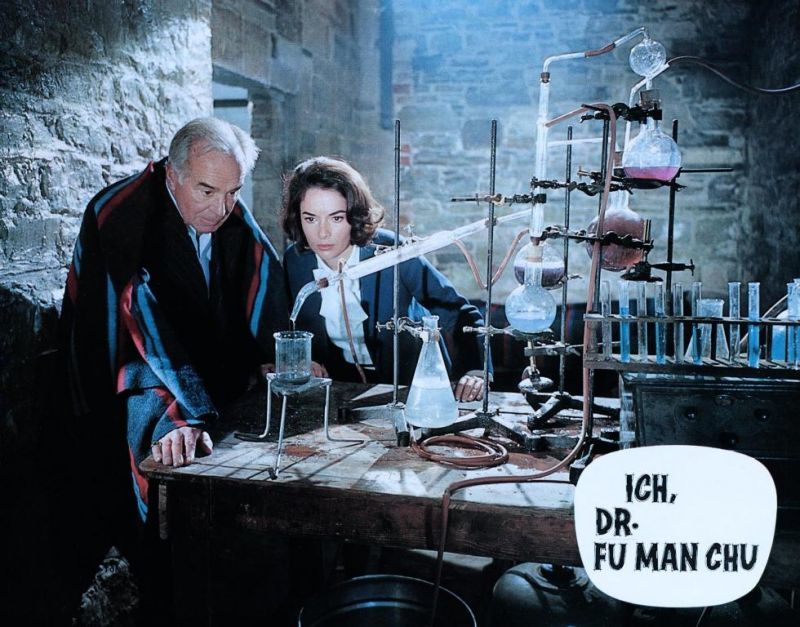
Following my recent Karin Dor bio I rewatched The Face of Fu Manchu (1965), the first of the Harry Alan Towers produced Fu Manchu movies starring Christopher Lee.
The Face of Fu Manchu was a co-production with Constantin Films from Munich so this features a number of German stars that add a lot of Krimi vibes.
Krimi’s dream couple Joachim Fuchsberger and Krimi Dor are re-united again.
Fuchsberger is clearly doubled in some of the fight sequences which is atypical for him as he was an experienced Yudoka and did most of the stunts in the Krimis himself.
As similar as their performances are in this film in comparison to their Krimis, there is a major difference here: For Face Dor and Fuchsberger play a married couple whereas in the Edgar Wallace movies (or their clones) they usually play characters that during the course of the mystery meet, get attracted to each other and then by the end of the movie finally get together (usually after Fuchsberger saves Dor).
As such Face nearly feels like a continuation of one of their Krimi adventures.
Also Walter Rilla plays Dor’s father. Rilla had not just acted in the Edgar Wallace Krimis Der Fälscher von London/The Forger of London (1961) and Zimmer 13/Room 13 (in which he is also Dor’s father with Fuchsberger as her suitor, 1964) but in several of the 1960s Dr Mabuse movies had played Prof. Pohland, the head of the psychiatric institution in which Mabuse ends up. Pohland’s mind eventually gets taken over by Mabuse and he becomes his de facto successor.
And in Face he is now a scientist on the verge of developing a super lethal poison who gets kidnapped and forced to work for Fu Manchu.
Did I mention that though notably set in the 1920s, this movie appears to be based in some imaginary time frame with cars, planes and fashion often belonging to different decades?
The early Sax Rohmer novels had quite a Holmes/Watson vibe in the dynamics between Sir Nayland Smith and Dr. Petrie that is carried over to the pairing of Nigel Green and Howard Marion-Crawford.
So with all that in mind…. Am I alone in thinking how amazing a Wallace/Fu Manchu/Sherlock Holmes/Mabuse mashup would have been? The mind just boggles at the thought of it but at least in my overactive imagination the seed of such a project is already hidden in The Face of Fu Manchu.
“Miss Krimi”, Karin Dor was one of Germany’s most popular actresses and the female face and figure head for the German Krimi-wave, the female equivalent for her frequent partner in crime (or should that be: crime fighting) Joachim Fuchsberger.
Yet ironically, even though her image was so closely related to Krimis she actually only featured in five of the original Rialto Edgar Wallace series in the early years of the Krimi wave (The Terrible People, The Green Archer, The Forger of London,Room 13, The Sinister Monk), however, did also star in a number of rival productions as well: The Invisible Dr. Mabuse, The Carpet of Horror, Die weiße Spinne[The White Spider], The Strangler of Blackmoor Castle (inspired by Bryan Edgar Wallace), The Secret of the Black Widow and Hotel der toten Gäste [Hotel of the Dead Guests].
She was so popular in that field that she even became one of the leads in the colour production Ohne Krimi geht die Mimi nie ins Bett (1962). Not a Krimi parody per se, the title as well as the popular title song, however, roughly translates as “Mimi never goes to bed without a crime novel” and references a Krimi addicted character, something very familiar to many in 1960s Germany.
Together with Joachim Fuchsberger she also helmed The Face of Fu Manchu (1965), the first of five Fu Manchu films starring Christopher Lee.
In her roles, Dor predominantly represented a non-threatening beauty that men could chastely admire and women could aspire to without ever feeling threatened. Known for her powerful screams, she was a genuine Scream Queen before that term was invented and was the quintessential damsel in distress that needed saving by the hero with whom her characters would typically become romantically involved by the end of the film. Her typical character was more passive victim than active participant and both in her Westerns as well as her Krimis (and especially when directed by her husband) she ended up frequently tied up.
For the most part there wasn’t much fatale about this femme and even when she starred as the first and so far only German Bond Girl in her biggest international success You Only Live Twice (1967), she did not display the Phoaaarrrr kind of sex appeal of that is often associated with that type of role.
Dor was so typecast with the role of the helpless victim that it came as a total shock when she was finally being outed as the razor blade wielding psycho serial killer in the proto-giallo scenes of Room 13 (1963).
Karin Dor was born Kätherose Derr in Wiesbaden.
As a school girl she already attended acting classes and worked as an extra in some movies.
In Harald Reinl’s Rosen-Resli (1954) she had a small role and only spoke one line but the 16-year old caught the attention of the director who was not only 30 years her senior but also one of Germany’s most influential and powerful film makers.
They got romantically involved and soon after married. In order to obtain her wedding licence Dor pretended to be 2 years older than she was which over the years led to misinformation as to her true year or birth.
In the early years her husband was the main driving force behind her career. Following Rosen-Resli he next cast her the same year in Der schweigende Engel [The Quiet Angel] in a more important role. They shot 20 movies together including the majority of Dor’s Krimi output starting with Die Bande des Schreckens/The Terrible People (1960) as well as Der Schatz im Silbersee/The Treasure of the Silver Lake (1962) and Winnetou - 2. Teil/Winnetou: The Red Gentleman (1964), two entries in the popular series of Karl May Westerns, and Die Schlangengrube und das Pendel/The Torture Chamber of Dr. Sadism (1967), a rare German Gothic Horror film re-uniting her with her Karl May co-star Lex Barker and Christopher Lee.
Dor and Reinl divorced in 1968.
They had a son, Andreas Reinl, who was born in 1955 when Dor would only have been 17. Andreas Reinl also became an actor and had his first role in 1980 in the 13th and final part of the Schoolgirl Report series of popular faux sex documentaries.
Karin Dor had her first involuntary international exposure with The Bellboy and the Playgirls (1962) when a very young Francis Ford Coppola was hired to re-cut and re-dub one of her German movies, 1958 production Mit Eva fing die Sünde an [Sin began with Eva], and added additional newly filmed nudie scenes for the American market.
Dor first gained popularity in a number of “Heimatfilme”, harmless comedies and other wholesome productions. Heimatfilme were a German phenomenon at the time. “Heimat” is a term that can roughly be translated with “homeland” or “motherland” and is a quintessential German term with lots of implications of home soil, being routed in the place you were born in etc. Heimatfilme were movies set in glorious countrysides, often in the mountains of Bavaria and depicting a clichéd perfect world and a naive antidote to the horrors of the recent war.
In the first half of the 1960s she became Krimi’s Leading Lady but also appeared in various other genres such as Western Movies (where she most prominently played Ribanna, Winnetou’s great tragic love interest in Winnetou: The Red Gentleman), adventure films and historical epics (the two-parter Die Nibelungen, at the time Germany’s most expensive production, was directed by her husband and a remake of a silent Fritz Lang classic), as well as Euro-Spy (The Spy with Ten Faces, 1966) and Euro-Horror (Paul Naschy’s Assignment Terror, 1970).
Her biggest international success next to You Only Live Twice - where she played a redhead hench-woman who ends up being killed in Blofeld’s piranha pool - was in Topaz (1969) where she is arguably at her most stunning as the head of a Cuban resistance group who is quite literally in bed with both sides. Even her death scene in a purple dress is beautifully staged by Alfred Hitchcock. It’s just a pity that, even though not devoid of some great set pieces, it’s still one of the lesser Hitchcocks.
Dor also appeared in a couple of popular US TV Shows: It Takes a Thief (next to Robert Wagner and Fred Astaire), Ironside and The F.B.I.
With the 1970s the time of big international productions was slowly coming to an end. Still reeling from her divorce in 1968 and battling cancer, she returned back to Germany where German commercial cinema lay all but dead after a new wave of German film directors had declared that “Grandpa’s Cinema Is Dead”.
Dor occasionally still played in smaller movies but until the end of her life became a semi-regular fixture in a variety of German TV series and also extensively toured Germany in a string of popular theatre productions.
Between 1972-74 Dor was married to Günther Schmucker, heir to the Asbach Weinbrand dynasty.
In 1985 Dor married stuntman George Robotham with whom she lived in residences in L.A. and Germany. The two of them stayed together until his death in 2007.
Following an accidental fall in 2016, Dor suffered brain injuries that ultimately required her to stay in a nursing home in which she passed away the following year.