A journey through Krimiland. Read all about the Teutonic fascination with Edgar Wallace, Bryan Edgar Wallace, Dr Mabuse, Jerry Cotton, Kommissar X, Father Brown or even Louis-Weinert Wilton and discover a world of hidden vaults, madmen in masks and bumbling butlers.
A slap given by one of the teachers (Konrad Georg) in a boarding school for boys is the catalyst for an escalating series of mysterious disappearances and murders and far reaching revelations.
Sieben Tage Frist is one of the few Krimis that is actually a bit more readily available. Under the title School of Fear a dubbed version can be found in some regions on Amazon Prime or Cultpix. Nevertheless, it is also one of the lesser known examples of the genre. Even on German TV it had only ever been shown once, yet a lot of people who have actually watched this often rate it as one of the best and favourite Krimis ever made.
The reason why the film may not automatically come to mind in discussions about the genre is that it’s not just not part of a series but indeed epitomises quite the opposite of classic Krimi as it’s generally known.
Shot in 1969 towards the end of the great Krimi era, this is a contemporary thriller based on the novel Sieben Tage Frist for Schramm [tr. “Seven Days Grace for Schramm”] by German author Paul Henricks.
In actual fact despite being directed by Alfred Vohrer and starring a couple of familiar Krimi faces, the film can easily be described as an anti-Wallace.
Set in a wintery landscape in the German Federal State of Schleswig-Holstein, the plot takes place in a boarding school for boys as opposed to all the various Rialto institutions for girls. Urban London is replaced by a barren coastal seaside that also features a solitary brothel with a somewhat blasphemous and political wall painting.
Students read underground magazines and use swear words. Bullying and animal cruelty is part of life for the school’s pupils.
Homosexuality was only fully decriminalised in Germany in 1994 but gay acts between adults above the age of 21 were already made legal in 1969, the year this film was shot, and a gay subtext clearly permeates this movie. We even get a glimpse of some brief full frontal male nudity.
And if that wasn’t enough at some stage we even get a Nazi war crime reveal.
For the most part Krimis were part of the German entertainment establishment of the 1960s and as such remained staunchly apolitical. Barring some mild references to the Third Reich in some of the earlier Mabuse films of the 1960s (small wonder given their pedigree), it is genuinely difficult to come up with other contemporary samples of the genre that contain elements of “Vergangenheitsbewältigung” (= coming to terms with the country’s past).
The student revolts of 1968 changed all that and left a big impact on German culture and society and this film is a reflection of this and an attempt to create a mélange of a traditional Krimi with a social awareness.
The link that ties those two spheres together is the employment of old school talent in front of and behind the camera.
Rather than use an up and coming director of the New German Cinema who had declared that “"Opas Kino ist tot” (Grandad’s cinema is dead), Luggi Waldleitner, the producer, wisely chose Alfred Vohrer to direct this production. Vohrer together with cinematographer Ernst W. Kalinke (another established Krimi-routinier) captured the bleak winter landscape remarkably well but also - typical for similar productions of the time - overdid the zooms.
This is Joachim Fuchsberger’s seventh and final collaboration with Vohrer and given the context of this production it is symptomatic that he no longer plays the dashing young hero but instead a teacher at the school, ie an older authority figure to the younger generation (albeit one that is most interested in solving the crimes).
Horst Tappert is the constantly (to the point of comical annoyance for the viewer) cigar-chomping-and-spitting investigating officer. Given that in real life Tappert a few years after his death was outed as having been a member of the SS, it is ironic that in this film he is one of the men responsible for revealing war crimes. One wonders what must have gone through his head when he shot this film. Did he ever ponder what would happen if his own involvement in Nazi atrocities became public knowledge?
The only one of the younger actors with anything resembling a film career was Frithjof Vierock who was mainly known as a comedy actor and at this stage had been in the business for close to a decade. For Arthur Richelman who plays Kurrat, the main pupil, however, this would remain his only feature film.
There is no debate: School of Fear is a highly unusual and more contemporary classic Krimi than anything else we have come to know from this genre. It is much more political, radical and socially conscious than the other series and for that reason alone it is worth a rediscovery.
And yet, I also can’t help but feel that it is this very contemporariness that also dates it more than its better known predecessors.
Nobody would accuse the Edgar Wallace Krimis to still be super current in 2024. They clearly have developed various sheets of patina but as they are set in an entirely fictitious universe that never really existed in the real world, they also contain a timelessness that School of Fear, a production clearly routed in 1969, lacks.
The German trailer has comments from the three leading actors that despite their lengthy résumés, none of them had ever been in a film that "hits the nerve" as much as this one.
The German PAL Region 2 DVD appears to also contain the English track and is available from Amazon UK, Amazon US and Amazon DE. It is, however, very pricey at this stage.
You know you've drunk the Jess Franco Kool-Aid when you find an old review from 2009 in which you slate this film and yet even though 13 years later all the points still hold true, they are now the reason you get such a great kick out of it.
Watched this film again at 4 o’clock at night. Maybe being spaced out from insomnia had a part to play as well, but this time I thoroughly enjoyed the movie, its odd angles and occasional hallucinatory day-for-night shots.
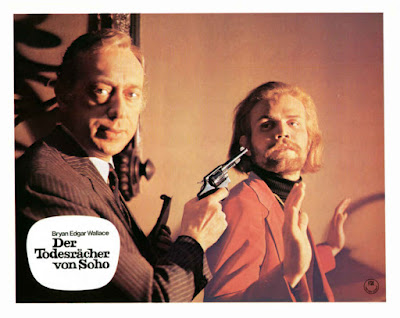
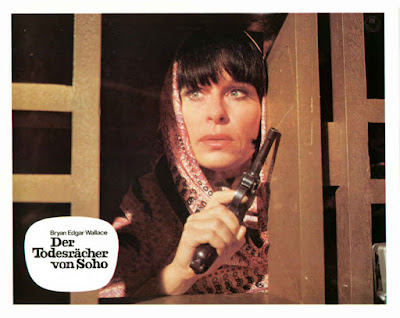
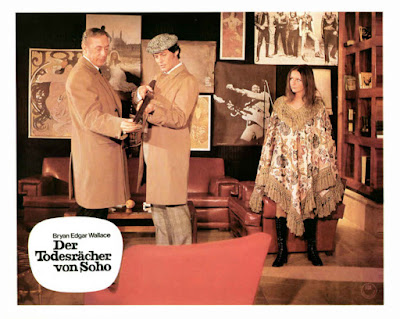
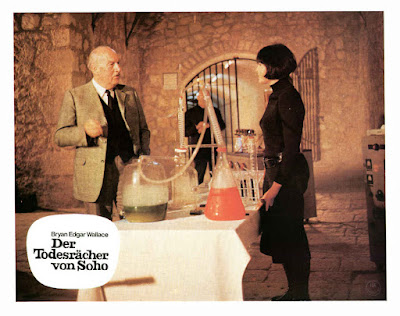
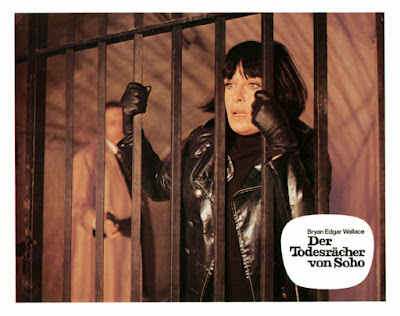
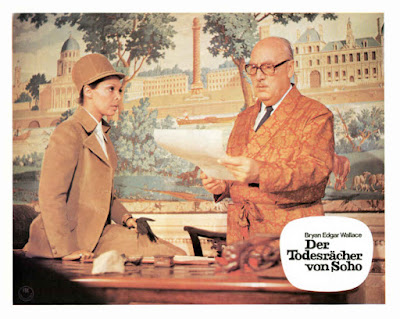
In order to pay penance for my prior lack of respect for Señor Franco, here are some German lobby cards for this last in the series of Bryan Edgar Wallace films by Artur Brauner’s CCC Film, a remake of its first entry (Das Geheimnis der schwarzen Koffer/The Secret of the Black Trunk, 1962), and also arguably the last classic Krimi.
When an influential talent agent (Kurd Pieritz) celebrates signing on Leila (Heidrun Hankammer), a glamorous dancer, for a dance troupe by bedding her in a hotel, he gets killed by knife by a mysterious masked killer with a glass eye. This starts a series of violent killings and Scotland Yard being confronted with an international gang of drug and girl smugglers operating out of London’s seedy Soho.
The Man With the Glass Eye is one of those Wallace films that doesn’t even pretend to be based on any of his novels anymore. Its development, however, is probably way more interesting than a straight forward adaptation would have been as this is an example where a rival production from a different studio initially influenced by the success of the Rialto Wallaces in turn influenced a film in the original series back again.
Ladislas Fodor, an author who had been very influential in creating the 1960s series of Mabuse movies, had also provided a screenplay for Artur Brauner’s CCC Film production Das Phantom von Soho/The Phantom of Soho (1964), allegedly based on Bryan Edgar Wallace’s novel Murder by Proxy, a book that does not, however, seem to exist. In his screenplay Fodor focused on a string of knife murders in London’s red light district, committed by a masked killer in revenge for the actions of a gang of drug and girl smugglers.
Which kind of is the entire premise of The Man With the Glass Eye as well! (Right down to the exact nature of the reason for the revenge.)
For Rialto’s production Fodor supplied a treatment under the title “Die grausame Puppe” [The Cruel Doll]. His involvement went uncredited and his treatment was reworked by Paul Hengge whose name features in the credits of Rialto’s 28th Wallace movie.
There is speculation as to whether Phantom of Soho’s screenplay may have simply been sold over to Rialto at the time. Whatever exactly happened remains unknown but the similarities between both movies are striking (and possibly a subject for a future blog post).
The Man With the Glass Eye combines both the best and the worst of the latter day Rialto Edgar Wallace films.
Alfred Vohrer’s 14th and final Wallace production is often a feast for the eye with wonderful Bavaesque lightning being employed right from the start when we see the first hotel room murder filmed in eery red and blue hues.
Prior to that the mood was already set when the initial credits announced cast and crew members’ names in flashing lights on top of images of Piccadilly’s and Soho’s neon lights.
The film oozes a sense for the bizarre and the off kilter and whereas earlier Krimis clearly influenced Italy’s own burgeoning Giallo genre, those Gialli now in turn appear to exert their own influence back to the Rialto films (until they would ultimately begin to totally merge for their last couple of entries).
Glass eyes - let’s face it: not the most common of sights in real life - are everywhere: the killer wears one; they’re left behind on crime scenes: “Glasauge” is the name of a billiard club whose membership card is a glass eye and whose villainous owner (Narziss Sokatscheff) also wears one; they can also be seen in a variety of dolls in an eccentric curio shop (that also incidentally contains a cuckoo clock with the head of a small dragon popping out on the hour, an item that I now really need to have).
A ventriloquist with an outrageously designed doll featuring an oversized egg shaped head, gets seemingly killed by his own puppet by a man bizarrely dressed up in a life-sized costume even when on the run and in a shootout with the police.
Plenty of memorable characters even in smallest roles. Burly twins (or at least lookalikes) are e.g. engaged in a bar room brawl. A performer wears an Old Shatterhand outfit. And of course we also have an iconic killer wearing an impressive combination of mask, glass eye, black gloves, cape and hat, the kind of vision you just want to see stalk London’s foggy streets.
And of course there are gimmicks galore. Realistically most of those are highly unpractical but a lot of fun to observe regardless: radio senders stored in shoe heels; a hidden machine gun behind a wooden panel; entire databanks of Interpol and other police force members in a rotating filing cabinet in a billiard club that also contains enough surveillance equipment to make a Mabuse proud; elaborate remote control mechanisms at the home of a wannabe playboy including a seated glass compartment on train tracks for the convenience of visitors that is so painfully slow that it would be much faster to simply walk the few steps rather than make yourself comfortable in there.
Oh, and did I mention Peter Thomas being in top form yet again with a stellar musical score?
Despite all this, what does drag this film down considerably is an over abundance of silly humour.
True, the Rialto Wallaces always had some humoristic elements in them but even though one would be hard pressed to call them subtle, for this production the comedy is at its crassest and worst.
Stefan Behrens (in his one and only Wallace film and at the beginning of his career) plays Sgt. Pepper [sic!] as an irritatingly squeaky voiced comic relief. The character of Sgt. Pepper was carried over from the previous production, Der Gorilla von Soho/The Gorilla of Soho (aka The Gorilla Gang), where he was played in a straight fashion as a regular sidekick again next to Horst Tappert’s Insp. Perkins.
What Behrens is to Eddi Arent, Hubert von Meyerinck’s Sir Arthur is to Siegfried Schürenberg’s Sir John. Both actors took over the batons from comedic actors that left an indelible mark in the Rialto Wallace series and then cranked the format up to Level 11 where it became utterly unbearable.
This is von Meyerinck’s third performance as Sir Arthur (and his 5th and final one in the series overall) and he is as loud and unpleasantly pervy as expected from him. He is both a bombastic and ignorant caricature of a Prussian General as well as a grotesque poster child for harassing bosses everywhere. His constant (but very willing!) object of attraction is Ilse Pagé (also in her 5th and final appearance in that series) as his secretary Mabel. Pagé’s Mabel was always ditzy but during the course of her films morphed into the most obnoxious stereotype of the Dumb Female.
And if those characters alone weren’t enough: The film is chockfull of the lowest kind of gutter humour with added over-the-top effeminate camp gay displays. At one stage a barkeep explains to Sir Arthur how to create a cocktail by telling him to “blow hard, else it won’t get stiff”. That kind of line makes the Carry On series look like the epitome of sophistication.
There is exactly one scene where the humour works and that ironically is one that may have gone right over the heads of a lot of the original German audience at the time: When the girls get locked into the back of a van, a sign on it in English states that it contains “fresh meat”.
Another drawback is that there is not a single character, male or female, who could genuinely serve as a protagonist or even hero or heroine that the audience could root for. The closest The Man with the Glass Eye comes in this regard is Horst Tappert’s Scotland Yard inspector who is ultimately, however, way too charmless and dull to genuinely engage with.
Then again, it seems that the German audience does enjoy charmless and dull when it comes to their fictional detectives as just a few years later Tappert started to feature in Derrick, a TV crime series that ran over 25 seasons from 1974-1998. Derrick also sold well abroad (in places such as Italy, the Netherlands and Scandinavia). His portrayal was not too far removed from his Inspector Perkins and it also featured Fritz Wepper as his assistant Harry Klein.
The two actors first met on The Man with the Glass Eye where Wepper plays Bruce Sharringham, a drug addicted member of an aristocratic family, in love with Karin Hübner’s dancing girl Yvonne Duval much to the dismay of his wonderfully snobbish and domineering mother (Friedel Schuster).
A lot is packed into the plot of this film, probably too much for its own good, so in the end it is often drowned in a plethora of different plot points without giving the right amount of focus to all those varied strands. The doomed love affair between those two characters e.g. for the longest time often feels totally out of place and just fizzles out among all the other plot strands and yet it is only towards the end that its true implications are revealed and one wishes it had been built up much stronger.
[WARNING: SPOILERS AHEAD - SKIP UNTIL THE END OF SPOILERS NOTICE IF NEEDED]
The Man With the Glass Eye has a tragic ending that similarly to Room 13 managed to pull at the heart strings in a way that very few others in the series with more conventional endings ever managed to succeed in doing.
Karin Hübner’s Yvonne is revealed as being a girl who had previously been abducted and forced into prostitution. She now seeks revenge on her former tormentors, most of all her lover’s mother who had been acting as the true eminence grise behind the gang and ends up killing Yvonne shortly before Scotland Yard and her fiancé can come to the rescue, leaving Fritz Wepper’s character both in mourning over the death of his true love and the betrayal of the mother he had always worshipped.
Rather than being a regular Wallace super villain, Yvonne had been a benevolent vigilante who saved hundreds of girls from the kind of fate that she had had to endure herself.
[END OF SPOILERS]
Apart from this love affair we have the knife killings of the glass eyed killer, a separate string of killings amongst the dance crew, a gang of girl smuggling white slave traders and drug deals taking place with the help of specially prepared billiard queues.
All of those do somewhat come together at the finale which, however, does not prevent a feeling of at times being overburdened by way too many diverse elements that don’t all join together as a consistent unity.
The fact that Rialto is clearly a representative of “Grandfather’s cinema” despite attempting to go with the times in their depiction of nudity, violence and drug use is very obvious when we see that every single one of the heroin users in this film just greedily gulps it down. Just a few short years away from the scenes depicted in Christiane F. here are film makers that don’t seem to comprehend the idea that the vast majority of heroin users would either inject, smoke or sniff and snort it but never really eat it.
Some choreographed dance scenes in this production were lifted from the film Scala - Total Verrückt (1958, translates as: "Scala - Totally Crazy"), a CCC variety show comedy directed by and featuring Eric Ode who late become one of Germany’s most popular TV detectives in Der Kommissar.
All in all The Man With the Glass Eye is a stunning looking swan song for Alfred Vohrer’s time with Rialto. Containing a Giallo flair, this is quite bloody at times with occasional glimpses of nudity and a wonderfully tragic ending that is only marred by an overabundance of cheap humour and a confusion of too many divergent plot elements.
AVAILABILITY
The Man With the Glass Eye is available as an English friendly standalone DVD with English subtitles and dubs but also featured in the final set (Edition 8) of the Edgar Wallace Edition together with the last four films of the series and of course also in the complete Rialto Wallace DVD Edition.
These are PAL Region 2 releases and can best be ordered via Amazon DE. Usually if bought from outside the EU ordering from there may be subject to customs charges but they may also show up as import discs on Amazon UK or Amazon US.
The film is also available in the same English friendly format on a German Blu Ray. Whereas the DVD Box releases were chronological for the Blu Ray box sets the films were published in a more random order and this movie appears on Blu-Ray Edition 9 with two other films. Just like on DVD there is also a boxset with the complete Rialto Wallace Blu Rays.
For anyone splashing out on the complete sets (either on DVD or Blu Ray): Only about two thirds of those are English friendly.


.jpg)