Monday, June 16, 2025

Der Hund von Blackwood Castle/The Hound of Blackwood Castle (1968)

Giallo Cobra, Hund von Blackwood Castle, poster, Karin Baal, Edgar Wallace

When Captain Wilson (Otto Stern) unexpectedly dies, his daughter Jane (Karin Baal) is due to inherit his castle. She soon discovers that a string of suspicious characters also show an interest in the ancient building. It all seems to be connected with an old jewellery heist. Everybody congregates at the local inn to the initial delight of the eccentric old female inn keeper (Agnes Windeck) who much to her dismay, however, quickly realises that her guests die faster than they can pay their bills. 

GiHund von Blackwood Castle, poster, Karin Baal, Edgar Wallace, Horst Tapper, Heinz Drache

 Der Hund von Blackwood Castle/The Hound of Blackwood Castle (1968) was Rialto’s 25th Edgar Wallace production and is a total hoot and pure unadulterated fun. 

It wasn’t based on any actual book by Wallace himself but - as a quick look at the title alone will tell - instead clearly inspired by at least elements of Sir Arthur Conan Doyle’s The Hound of the Baskervilles.

 Several killings are courtesy of a vicious Doberman with poisonous fangs that roams the Moors which in a roundabout way does bring us back to Wallace again. After all in 1931 he had written the screenplay for the first sound version of this Sherlock Holmes novel. 

Mysterious inheritances have also always been a popular trope for this writer and especially the idea of having a gang meet up again years later to finally get their hands on loot that the gang leader had absconded with bears quite a resemblance to Wallace’s play/novella The Terror that would subsequently be adapted by Rialto as Der unheimliche Mönch/The Sinister Monk (1965). 

GHund von Blackwood Castle, poster, Karin Baal, Edgar Wallace

 Hound begins with one of Peter Thomas’ most manic and crazed title songs so that right from the start the audience is aware that director Alfred Vohrer together with screen writer Herbert Reinecker (aka Alex Berg) have pulled no punches to deliver their own curious brand of cinematic Wallace madness. 

The presence of reptiles in a Krimi was always something of a Vohrer trademark so it will come as no surprise that snakes feature prominently in this production, most notably when Karin Baal in her second Wallace production (after The Dead Eyes of London, 1961) gets threatened by one of them. 

 But we also get a brutish one eyed butler (Arthur Binder), a giant stuffed polar bear with a hidden telephone, dangling skeletons, paintings falling off the wall and cobwebs galore. 

And quick sand! (Where would we ever be without quick sand?) 

And a mysterious castle crypt with a remote controlled sarcophagus containing a vanishing corpse. The film is remarkable in that it for once does not feature a younger Scotland Yard investigator. Instead Sir John (Siegfried Schürenberg) takes the case over himself in his own inimitable style and with the help of Ilse Pagé as Miss Mabel Finley. 

For the most part Hound relies on new or lesser known faces but we do still get Heinz Drache as an insurance inspector with a secret. His character is named Humphrey Connery (sic!) and writer Reinecker was further inspired (or should that read: uninspired) by classic film stars when Horst Tappert in his Wallace debut gets introduced as Douglas Fairbanks. 

Tappert’s gang member when faced with the spooky shenanigans in the castle can often be seen in panic mode which makes for a welcome change of pace when compared to his usual hangdog expression in other films or series. 

He is accompanied by Uta Levka. Her gangster moll was her third and final appearance in a Wallace film following Der unheimliche Mönch/The Sinister Monk (1965) and Der Bucklige von Soho/The Hunchback of Soho (1966). 

One of the standout performances is courtesy of Mady Rahl who plays Captain Wilson’s divorced wife and Jane’s mother. When we first meet her she is a performer in the Red Rose Cabaret but still under delusions of grandeur and longing for the days of former glory. She sees her daughter’s inheritance as her final chance to regain the life status she clearly thinks she deserved. 

Also look out for Hans Söhnker as the dubious lawyer who is trying to sell off the castle well under value. Söhnker had previously played Prof Moriarty in Terence Fisher’s Sherlock Holmes and the Deadly Necklace (1962) and was Sir Philip, the Head of Scotland Yard, in the Bryan Edgar Wallace production Das Phantom von Soho/The Phantom of Soho (1964).

Giallo Cobra, Hund von Blackwood Castle, poster, Edgar Wallace

Wednesday, May 28, 2025

Karin Baal (September 19, 1940 - November 26, 2024)

Karin Baal

Following her death last year I decided to explore Karin Baal’s career a little bit. 

Having had no previous acting experience and coming from a poor working class background, the 15-year old Baal was instantly catapulted to stardom when she was chosen as the female lead next to Horst Buchholz in the juvenile delinquency drama Die Halbstarken/Teenage Wolfpack (1956) in which she played a seductive rebellious teenager. 

 Given her lack of acting nous for this production she was dubbed by Brigitte Grothum (who would later also feature in Das Gasthaus an der Themse/The Inn on the River and the CCC Wallace Der Fluch der gelben Schlange/The Curse of the Yellow Snake). 

The film was not just a tremendous success at the box office but it aligned with the Zeitgeist and struck a chord with the post-war generation for whom Baal became an instant icon. 

Baal became known as the “German Brigitte Bardot” and for a while was typecast in roles similar to the ones she had played for her debut. 

Over a decade, she appeared in three Rialto Wallaces and with her roles went from naive ingénue to confident young woman and middle aged wife. 

In Die toten Augen von London/Dead Eyes of London (1961), she is Nora Ward who first assists Fuchsberger’s inspector with reading messages in braille and then becomes a crucial part of the mystery.

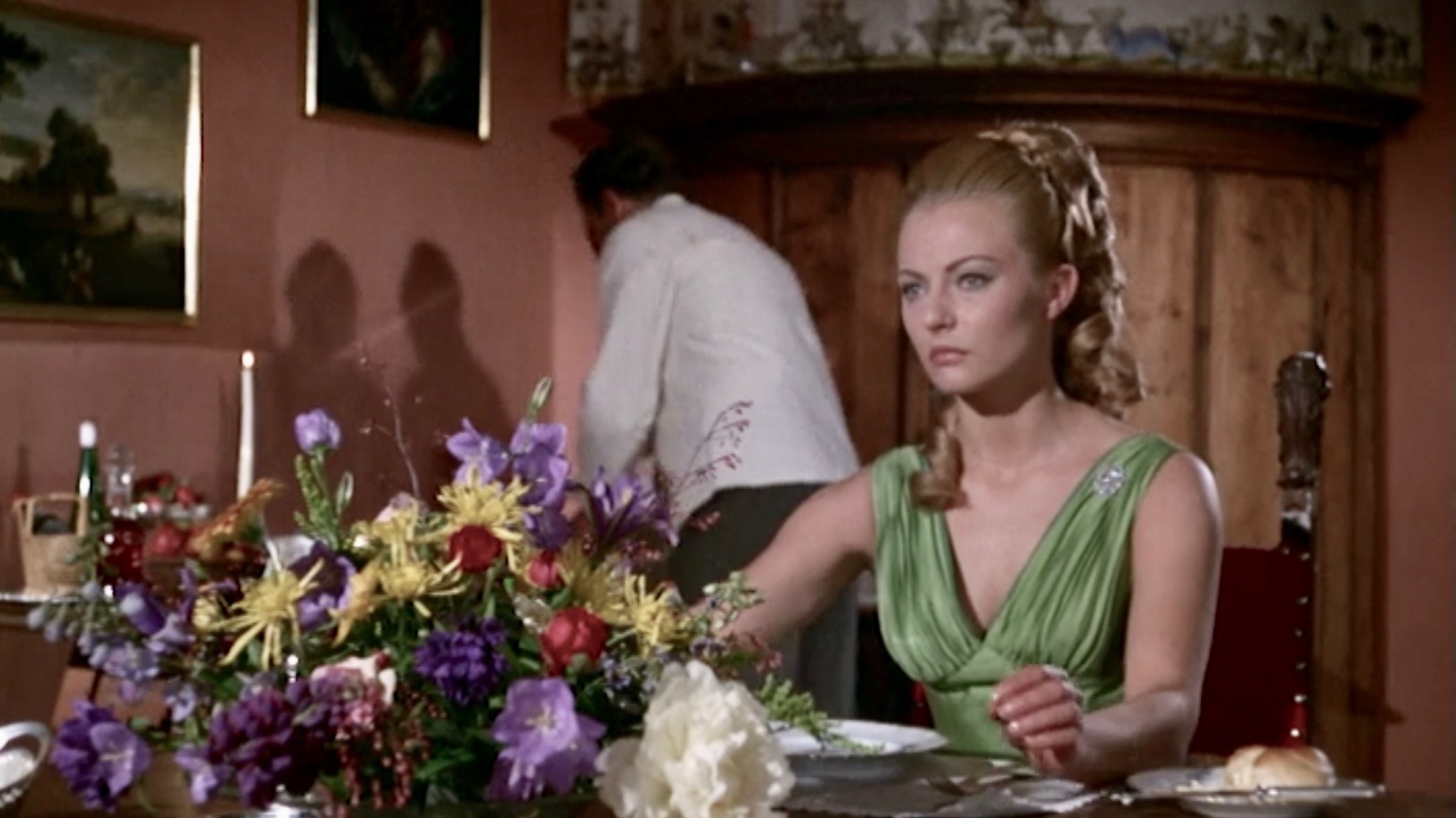
 In Der Hund von Blackwood Castle/The Monster of Blackwood Castle (1968) she plays the stylish heiress of a mysterious castle that becomes the focal point for a series of strange killings. 

 She reunited with Fuchsberger for the Krimi/Giallo hybrid Das Geheimnis der grünen Stecknadel/What Have You Done to Solange?/Cosa avete fatto a Solange? (1972) in which she is the frumpy wife of Fabio Testi's philandering sports and Italian teacher. Once she learns to accept her husband’s slimy cheating ways she dons eye shadow again, wears a negligée and lies lasciviously on her bed when not helping him to investigate the murders and free him from suspicion. 

Baal starred next to Oliver Reed in Michael Winner’s Hannibal Brooks (1969) though international stardom eluded her. 

She was, however, a constant feature in German cinemas, on TV as well as on stage. In the 1980s she became a muse for Rainer Werner Fassbinder and featured in three of his productions: the then controversial TV series Berlin Alexanderplatz (1980) and the two movies Lili Marleen und Lola (both 1981). 

She can also be seen in Hans-Christoph Blumenberg’s Tausend Augen (1984, tr. “Thousand Eyes”) in which she plays an elderly ticket lady at a strip joint who spies on her boss to the female head of a mafia-like ring of video pirates. Despite not being an actual Mabuse film, this movie does carry a lot of Mabusian references and undertones. 

Though professionally successful and publicly celebrated, Baal’s private life was often turbulent. She was married four times, battled alcoholism and, not having properly secured her finances in preparation for retirement, faced poverty in her old age.

She published her memoirs in 2012 under the title Ungezähmt: Mein Leben (tr. "Untamed: My Life").

Karin Baal, Horst Buchholz, Die Halbstarken

Karin Baal, Mario Adorf

Karin Baal, Ady Berber, Dead Eyes of London, Edgar Wallace, Rialto

Karin Baal, Hound of Blackwood Castle, Edgar Wallace, Rialto

Karin Baal, Joachim Fuchsberger, What Have you done to Solange?, Edgar Wallace, Rialto
Karin Baal, Hannibal Brooks

Karin Baal, Lola


Tuesday, March 25, 2025

Eureka Blu-Rays (and the new Bare*Bones magazine)

Dr Mabuse, Eureka Entertainment, Fritz Lang

Thanks to Eureka Entertainment there has never been a better time to be an international Krimi Fan as they have started releasing a number of German Krimis in English friendly versions!

First up: Mabuse Lives! Dr Mabuse at CCC 1960-1964

This sumptuous box set collects all the Mabuse movies from the 1960s and amongst the extras contains an article by me in its limited edition 60-page collector’s book.

The set is officially out on March 31, 2025 but I have already seen photos from one fan who received theirs a few days earlier.

The set can also be purchased on Amazon US or Amazon UK.

You can still listen to my guest performance on Rod Barnett's Bloody Pit of Rod podcast where we discuss the series or check out my little book The Many Masks of Dr. Mabuse: Mabuse in the 1960s. I had also contributed a Mabuse related article to The Sensational Sixties #10 magazine.


Edgar Wallace, Bryan Edgar Wallace, Krimi, Eureka Entertainment


Next up: Terror In The Fog : The Wallace Krimi at CCC

This set is out May 26, 2025 and features several Bryan Edgar Wallace Krimis and one non-Rialto Edgar Wallace adaptation from CCC Studios.

I have again contributed an article for its collector's booklet. Pre-orders are now taken and this is also available from Amazon US or Amazon UK.


bare*bones magazine, Kommissar X

And last but by no means least: 

The latest issue of bare*bones magazine (Winter 2025) contains an article about the Kommissar X film series again written by yours truly.

Find it here (Amazon US) or here (Amazon UK).

And don't forget to also check out my appearance on the Cult Connections podcast where I chatted about Kommissar X. That show was the inspiration for me to write this magazine article.


Sunday, February 16, 2025

The Etruscan Kills Again/The Dead Are Alive/Das Geheimnis des gelben Grabes (1972)

Bryan Edgar Wallace, The Dead Are Alive, The Etruscan Kills Again

Just discovered these couple of lines that I penned a good few years ago. I don't think I had published them anywhere before so decided I might as well pop them up here on this blog given the connection to Bryan Edgar Wallace. I definitely need to rewatch this film some time soon again as I can't remember much from it at this time.

The history of Bryan Edgar Wallace movies still had a little epitaph in the form of The Etruscan Kills Again aka The Dead Are Alive, an Italian Giallo allegedly based on one of his novels but really a standalone project that just availed of his name to drum up a little publicity. 

 Directed by Armando Crispino and featuring a range of excellent and familiar but not too familiar (and therefore affordable) actors such as Samantha Eggar, Alex Cord, John Marley, Horst Frank and Nadja Tiller this film is beautifully set in the uniquely scenic Italian countryside among ancient Etruscan ruins. When an ancient graveside gets unearthed a series of often quite graphic murders shocks the archaeological community but could the old Etruscans really have come back to life or is the solution a bit more mundane? 

 This is a lesser known and often maligned entry into the giallo genre but the truth is that it is if not necessarily good but then at least a very entertaining production with decent production values that lives through its assortment of dubious and often disturbed characters: psychotic alcoholics with black outs, camp choreographers, violent bigamist conductors the image of Herbert von Karajan, cheating wives and mysterious ex-wives with their own secrets all make up part of this fun ensemble. 

 Riz Ortolani with help from Giuseppe Verdi provides the memorable score that underlines the grisly killings. 

 The solution won’t come as a major surprise to anyone who’s ever seen a giallo but as usual it is a case of style over substance in these type of films and this flick sure deserves to be better known amongst cognoscenti of this sub-genre.

Thursday, January 30, 2025

Harald-Leipnitz-Strasse in Wuppertal

Harald Leipnitz, Wuppertal
 

Harald Leipnitz features in the Rialto Wallace Krimis Die Gruft mit dem Rätselschloss/The Curse of the Hidden Vault (1964), Der unheimliche Mönch/The Sinister Monk (1965) and Die blaue Hand/Creature with the Blue Hand (1967).

He can also be seen in the Francis Durbridge TV-Mini Series Der Schlüssel (1965) and in other productions such as the Karl May Western Der Ölprinz/The Oil Prince (1965) and Winnetou und sein Freund Old Firehand/Winnetou: Thunder at the Border (1966) as well as The Brides of Fu Manchu (1966) and a plethora of other popular German movies and TV series.

He was born on April 22, 1922 in Wuppertal, the same city that Horst Tappert was also born in. A while ago I discovered that this city in North Rhine Westfalia named a street after him in his honour in the Elberfeld suburb that he originally came from.

Once I heard this I started developing this crazy idea that maybe some day I should venture there but a quick look at Google Maps reveals that realistically other than the street sign there is very little to explore there so will remain an armchair tourist in this regard but thought it would be cool to share this find with the rest of the world.

Harald Leipnitz, Edgar Wallace, Rialto
Harald Leipnitz, Karl May

Harald Leipnitz, Karl May


Thursday, January 23, 2025

Der Hund von Blackwood Castle/The Hound of Blackwood Castle (1968) - Lobby Cards

 Am planning to post a review of this movie soon but in the meantime enjoy this collection of German lobby cards for this production.


Der Hund von Blackwood Castle, The Hound of Blackwood Castle, Krimi, Edgar Wallace, Rialto, Heinz Drache

Der Hund von Blackwood Castle, The Hound of Blackwood Castle, Krimi, Edgar Wallace, Rialto, Horst Tappert

Der Hund von Blackwood Castle, The Hound of Blackwood Castle, Krimi, Edgar Wallace, Rialto, Karin Baal

Der Hund von Blackwood Castle, The Hound of Blackwood Castle, Krimi, Edgar Wallace, Rialto, Horst Tappert

Der Hund von Blackwood Castle, The Hound of Blackwood Castle, Krimi, Edgar Wallace, Rialto, Horst Tappert

Der Hund von Blackwood Castle, The Hound of Blackwood Castle, Krimi, Edgar Wallace, Rialto, Heinz Drache

Der Hund von Blackwood Castle, The Hound of Blackwood Castle, Krimi, Edgar Wallace, Rialto, Heinz Drache, Siegfried Schürenberg

Der Hund von Blackwood Castle, The Hound of Blackwood Castle, Krimi, Edgar Wallace, Rialto, Heinz Drache

Der Hund von Blackwood Castle, The Hound of Blackwood Castle, Krimi, Edgar Wallace, Rialto, Heinz Drache

Der Hund von Blackwood Castle, The Hound of Blackwood Castle, Krimi, Edgar Wallace, Rialto, Horst Tappert

Der Hund von Blackwood Castle, The Hound of Blackwood Castle, Krimi, Edgar Wallace, Rialto

Der Hund von Blackwood Castle, The Hound of Blackwood Castle, Krimi, Edgar Wallace, Rialto, Karin Baal

Der Hund von Blackwood Castle, The Hound of Blackwood Castle, Krimi, Edgar Wallace, Rialto, Karin Baal

Der Hund von Blackwood Castle, The Hound of Blackwood Castle, Krimi, Edgar Wallace, Rialto, Karin Baal

Der Hund von Blackwood Castle, The Hound of Blackwood Castle, Krimi, Edgar Wallace, Rialto, Siegfried Schürenberg

Der Hund von Blackwood Castle, The Hound of Blackwood Castle, Krimi, Edgar Wallace, Rialto

Der Hund von Blackwood Castle, The Hound of Blackwood Castle, Krimi, Edgar Wallace, Rialto,

Der Hund von Blackwood Castle, The Hound of Blackwood Castle, Krimi, Edgar Wallace, Rialto, Karin Baal

Der Hund von Blackwood Castle, The Hound of Blackwood Castle, Krimi, Edgar Wallace, Rialto

Der Hund von Blackwood Castle, The Hound of Blackwood Castle, Krimi, Edgar Wallace, Rialto

Der Hund von Blackwood Castle, The Hound of Blackwood Castle, Krimi, Edgar Wallace, Rialto

Der Hund von Blackwood Castle, The Hound of Blackwood Castle, Krimi, Edgar Wallace, Rialto

Der Hund von Blackwood Castle, The Hound of Blackwood Castle, Krimi, Edgar Wallace, Rialto

Der Hund von Blackwood Castle, The Hound of Blackwood Castle, Krimi, Edgar Wallace, Rialto


Wednesday, January 15, 2025

Operation St. Peter’s (1967)

Operation St Peter's, Die Abenteuer des Kardinal Braun, Heinz Rühmann, Lucio Fulci, Uta Levka

If you read Krimi! 0 (and if you haven’t: What’s stopping you?), you'd have learnt that the commercially most successful Krimi in Germany was surprisingly not one of the Rialto Wallace’s but the GK Chesterton Father Brown adaption Das schwarze Schaf (tr. “The Black Sheep”, 1960), a film that never saw an English language release but that proved so popular with the audience that a follow-up was shot two years later: Er kanns nicht lassen (tr. “He can’t help it”, 1962). 

Father Brown was played by Heinz Rühmann, one of the most popular German actors ever with a career ranging over more than 5 decades. He was a quiet comedian, usually playing a kind-hearted Average Joe. 

Those two films were the only two adaptations that can genuinely be considered classic Krimis, however, they generated one last footnote: the Italian comedy Operazione San Pietro/Operation St. Peter’s (1967), directed by none other than Lucio Fulci. In Germany this film was marketed as Die Abenteuer des Kardinal Braun (tr. “The Adventures of Cardinal Brown”). 

Father Brown has now been promoted from small English priest to a Vatican based Cardinal and the film unfortunately is a complete mess and really for completists only. 

 One of the main issues is that it can’t decide whether it wants to be a standalone film or whether it wants to act as a continuation of the earlier two films. 

The trouble is that as a continuation of the series, the film is very badly written with the Brown character appearing first after more than 40 minutes. Even subsequently he has very little to do, does practically no detecting work of any kind other than ordering each and every Italian priest on a wild goose chase after the thieves of Michelangelo’s Pietà. 

That chase makes up at least 20 minutes of the final movie and as such may be considered overdone, though it has some effective scenes of entire religious orders storming out of their monasteries in their different frocks running up and down the country in various formations. Some of those scenes look quite stunning, I must admit. 

E.G. Robertson has one of his final parts as a babbling mafia don in fear of the vicious beating he once received from his peers. Cue: Black and white flashback à la introductory sequence of The Beyond. 

Uta Levka of Edgar Wallace fame as well as of Scream and Scream Again and The Oblong Box has a much bigger and more talkative part than usual and does look quite dishy. Thanks to the crystal clear pause function of modern DVDs you can also catch a nice topless glimpse of her that could otherwise be missed. (God forbid!) 

The comedy of the film is of a very daft Italian kind. It’s not even ludicrous enough to make you cringe, very harmless and predictable overall, not enough that it’ll have you slapping your laps with laughter. 

The film is only really available on a purely German language DVD without English subtitles or dubbing. Internationally, even amongst Fulci fans, this production is hardly known at all. 

Stephen Thrower is one of the few scholars who wrote about this production in his excellent book Beyond Terror: The Films of Lucio Fulci but even he seems to miss the connection to the earlier movies. Instead he focuses on the radical Fulci critique of the Catholic Church in films like The Eroticist and considers Operazione flawed as the humour against the Church is only very superficial and not deep enough. Rühmann’s character really never gets a proper mention other than in a small part of his synopsis. For all intents and purposes Rühmann, however, was one of THE main characters and reason why the film managed to get the green light at all. Admittedly, this was a very badly written Father Brown entry, but a Father Brown entry nonetheless and as such there is no way that anyone would have wanted to even make it an anti-Church pamphlet. Father Brown films are by their nature pro-religious.

Operation St Peter's, Die Abenteuer des Kardinal Braun, Heinz Rühmann, Lucio Fulci

Operation St Peter's, Die Abenteuer des Kardinal Braun, Lucio Fulci

Operation St Peter's, Die Abenteuer des Kardinal Braun, Heinz Rühmann, Lucio Fulci, Uta Levka

Operation St Peter's, Die Abenteuer des Kardinal Braun, Heinz Rühmann, Lucio Fulci

Operation St Peter's, Uta Levka, Die Abenteuer des Kardinal Braun, Heinz Rühmann, Lucio Fulci

Operation St Peter's, Die Abenteuer des Kardinal Braun, Lucio Fulci,