A journey through Krimiland. Read all about the Teutonic fascination with Edgar Wallace, Bryan Edgar Wallace, Dr Mabuse, Jerry Cotton, Kommissar X, Father Brown or even Louis-Weinert Wilton and discover a world of hidden vaults, madmen in masks and bumbling butlers.
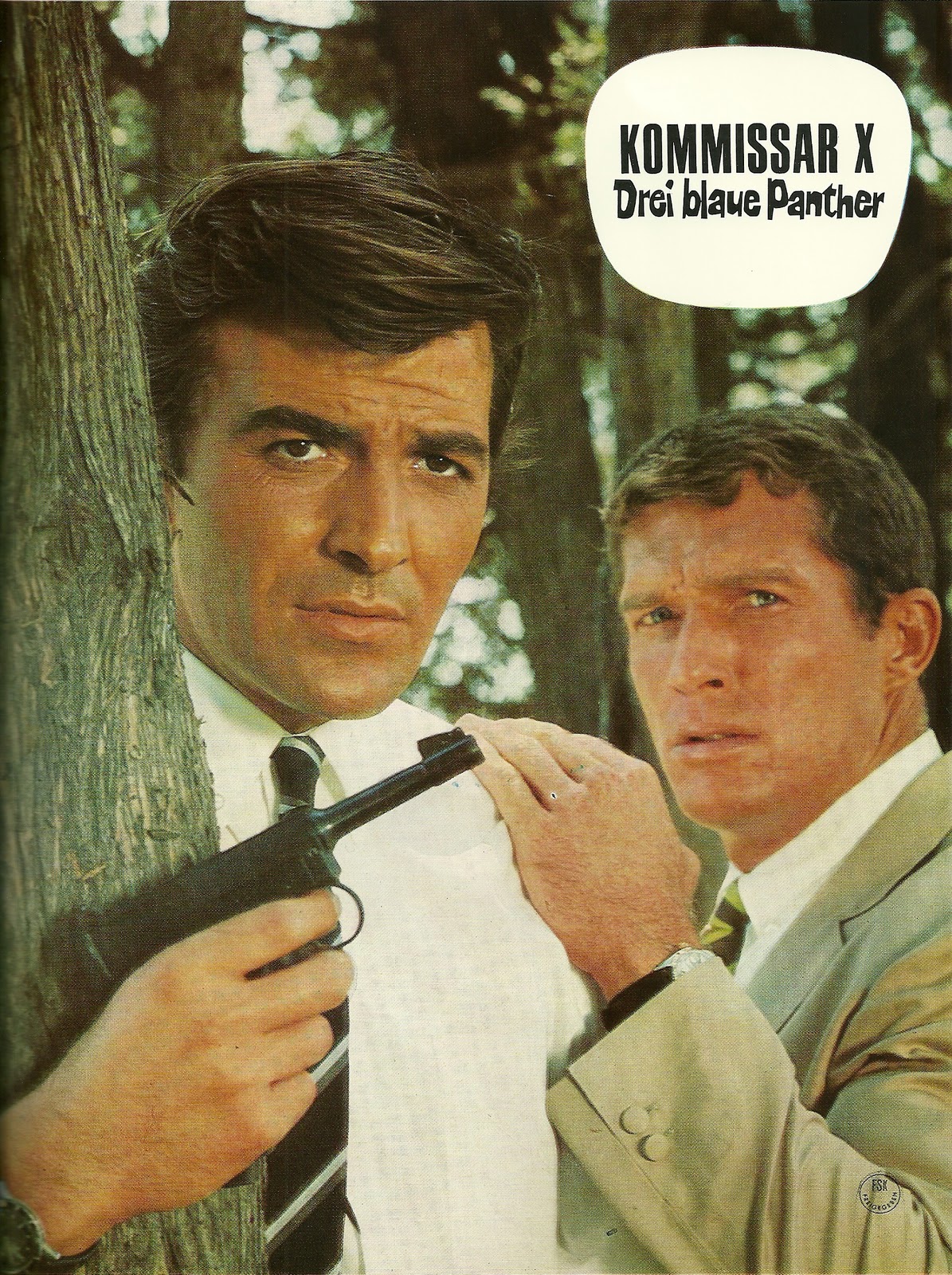
KOMMISSAR X is a series of seven German productions and - just like the JERRY COTTON movies - based on a popular Groschenroman/German Pulp Fiction series. Usually the movies are described as "Eurospy" though I always figured that the minimum requirement for that label would be to actually feature... well, spies. (I am having a similar issue seeing the JERRY COTTON movies described as Europsy.) And strictly speaking none of the characters are secret agents: One is womanising private eye Joe Walker (played by Tony Kendall), his sidekick a musclebound FBI agent with questionable dancing skills (Brad Harris).
All of these productions were, however, filmed in exotic locations and regularly feature our heroes battling against megalomaniac arch villains, so comparisons to the Bond series may not be so out off hand after all.
Unfortunately, none of the films have been released in any decent format yet. A Retromedia set of three of those from a while back also features washed out film stock panned to death and with missing scenes.
So if you're not familiar with the movies yet, try locating them no matter what. I have lobby cards for three of the films that I am now going to share with you starting with Kommissar X - Drei blaue Panther/Three Blue Panthers. Watch out for Erika Blanc!
When her husband, a gambler, is found killed in a car crash with a white spider as a key ring in his possession (his talisman but also the symbol for one of London's most notorious contract killer gangs) the insurance company refuses to pay for his life insurance and his wife (Karin Dor) is forced to work for her living in a reform society for convicts where she meets Ralph Hubbard (Joachim Fuchsberger) who was recently released from Dartmoor. Scotland Yard strongly suspects the wife of being involved in the killing but also needs to take drastic measures when one leading policeman is found dead as well. They bring in a mysterious Australian crime fighter who prefers to hang on to his anonymity and conducts his interviews hidden from view by a couple of beaming lights. One-eyed men, strange Indians and oh-so altruistic priests all stand in the way of solving the mystery behind the killings that shock London.
Following the success of Germania-Film's Teppich des Grauens/The Carpet of Horror, two small German film companies, Arca-Winston Films and Hans Oppenheimer Film, decided to co-produce another Louis Weinert-Wilton Krimi: Die weisse Spinne/The White Spider based on his debut novel from 1929.
For Arca-Winston this was their debut production that they followed up a year later with another Krimi Das Wirtshaus von Dartmoor/The Inn on Dartmoor before focusing on a dozen pseudo-documentary sex education movies. Hans Oppenheimer Film also didn't exactly set the cinematic world on fire with the couple of productions that they helmed.
Despite its non-distinguished parenthood The White Spider ended up being quite a fun Krimi entry and a step up from The Carpet of Horror. They obviously learned their lesson from looking at Carpet and not only hired its director Harald Reinl and the stars Joachim Fuchsberger (relaxed and likeable as usual), Karin Dor (way too irrationally panicky for my liking) and Werner Peters (in a surprise part playing a cop for a change) but also went a few steps further in Wallacefying the experience.
From the first scene onwards it becomes painfully obvious to the viewer what Carpet had been missing: Peter Thomas' weird jazzy kind of soundtrack, a screenplay written by an Edgar Wallace veteran and also more familiar faces in the supporting roles (as opposed to the Spanish actors that were by and large unfamiliar to the German public).
And The White Spider has all that in spades.
Peter Thomas replaced Francesco De Masi and now again added his typical vibes to the production.
The screenplay was written by a certain Albert Tanner who was none other than Egon Eis who, under the nom de plum Trygve Larsen, had also been the writer of the very first Rialto Wallace, Der Frosch mit der Maske/Fellowship of the Frog and who provided just the right mix of secret doorways, hidden gadgets and men in masks galore for this movie.
And instead of Spanish unknowns we have familiar German faces in even the smallest roles:
Horst Frank surprisingly enough never appeared in a proper Wallace production but was a very familiar villain in many a German movie, the kind of guy who got hired when Kinski wasn't available and here plays a knife wielding ex-convict up to no good. Chris Howland in real life was a wise cracking English radio DJ who had tremendous success in Germany and was Eddi Arent's replacement in some of the Bryan Edgar Wallace movies. Also look out for Dieter Eppler as a lawyer, Friedrich Schoenfelder as Sir James, the head of Scotland Yard, and Mady Rahl as an ex-stripper past her prime who finds a very grisly death.
The movie is fast paced, good fun and just the right thing to watch when you have already gone through all the original Rialto productions. If anything it is actually quite brutal for the time in its on-screen depictions of strangulations courtesy of Reinl who just can't keep his paws off a good piece of rope.
One of the most fun scenes must certainly be when we see Fuchsberger's character interview an old lady who ends up being anything but and involves him in a furious fight sequence.
There are two things, however, that could be listed as The White Spider's main shortcomings.
First of all the budget does not seem to have expanded to a trip to London or to the nearest stock library and as such is missing the all familiar clips of Big Ben, Tower Bridge et al. Instead we have typical German side streets trying hard (and failing badly) to pretend they're Soho and wintry scenes of an icy Hamburg harbour standing in for the Thames.
To make up for this lack of authentic scenery the crew appears to have taken every possible opportunity to plaster pictures of Queen Elizabeth II on every available office wall. Have a whisky for every time you spot a portrait of the Queen in The White Spider and you are bound to reach the end of the film in a comatose state.
Worst of all, however, is the complete and utter lack of proper mystery. If you have found my blog you already know enough about the typical roles played by each actor to know who in truth is the mysterious Australian inspector. And does anyone really trust Werner Peters as a fighter on the side of law and order?
Also, if you read this blog it is proof that you still have your proper eye sight. As such you will not find it remotely difficult to see through all those disguises of the master villain's attempt at being a Man of Half a Dozen Faces (or more to the point: a RINGER replacement).
None of that, however, matters much as the fun that can be had from this Krimi far outweighs weaknesses in the story department. After all, one does not really watch those movies for Nobel Prize winning plots but for a certain sense of mood and intrigue that is available here in bundles.
Again, this production has never been released on DVD but if you venture into Soho's darkest alleys you just may come across some one-eyed men able to locate a copy with English subs provided you swear ever lasting allegiance to the secret society they represent.
A set of lobby cards from my collection for one of the later Rialto Edgar Wallace movies: Im Banne des Unheimlichen (1968, aka The Zombie Walks or The Hand of Power for you Anglophones). Click on the pictures to get the full size scans.
German mystery author Louis Weinert-Wilton is a peculiar case. There are very few people (even in Germany) who have ever heard of him, even less who have read him. And I challenge you to come up with just one single person who would name him a favourite author.
Yet his books appear to have been successful enough to remain in print in Germany until the 1980s and spawn a series of four adaptations in the wake of Rialto's popular Edgar Wallace series.
He was born Alois Weinert on May 11, 1875 in Weseritz (Bezdružice), a small village in Bohemia, today part of the Czech Republic. Weinert was a Sudenten German, i.e. a member of the large group of ethnic Germans in that part of Europe and visited the military school in Pola, then part of the Austro-Hungarian Empire (today belonging to Croatia).
From 1901 he was first editor, later editor-in-chief with the “Prager Tageblatt”. During his time with the newspaper he also started writing a couple of primarily humorous plays for the stage. From 1921 on he managed the “Neues Deutsches Theater” in Prague.
Starting from 1929 on and under the slightly anglicized name of Louis Weinert-Wilton he published eleven mystery novels that were clearly inspired in style and substance by Edgar Wallace who was then one of the most popular authors in Germany. In actual fact Weinert-Wilton's novels were published by Goldmann, the very same publishing house that had made Wallace's novels so immensely popular throughout Germany and were only too anxious to also give a home grown author a chance. Especially if that author also had his plots play out in a smoggy London full of mysterious villains and courageous Scotland Yard officers.
Some of his books at the time were translated into Dutch, Portuguese and Italian, though none appear to have been published in English.
Drafted in to the war Louis Weinert-Wilton unfortunately died on September 05, 1945 in a Czech POW camp in Prague, at a time when Germany had already surrendered to the Allies and the war was effectively over. As such he would not see the continuing success of his books that resulted in four movie adaptations in the early 1960s.
These four movies - Der Teppich des Grauens/The Carpet of Horror (1962), Die weisse Spinne/The White Spider (1963), Das Geheimnis der schwarzen Witwe/The Secret of the Black Widow (1963), Das Geheimnis der chinesischen Nelke/Secret of the Chinese Carnation (1964) - can only very loosely be described as a series as they all were produced by different German companies in co-production with yet another bunch of different International production houses which probably explains at least part of the reasons why these films never received any proper DVD releases anywhere. The rights issues may very well appear to be a bit of a legal nightmare.
Der Teppich des Grauens/The Carpet of Horror was adapted from Louis Weinert-Wilton's second last book, written in 1938. And without a doubt carries what must be one of the most ludicrous titles in the entire cinema history especially given that the carpet scenes aren't actually all that horrific. The couple of instances that we see a carpet is when vials of poison are thrown on them causing near instantaneous deaths of the intended victims.
Germania-Film GmbH co-produced this Edgar Wallace clone with the Italian Domiziana Internazionale Cinematografica and Spanish Época Films S.A. As a result of this the film was not shot in Germany (as the usual case with the majority of Wallace productions) but in Spain though the film still easily retained the familiar faux English flair of the Krimis.
Helmed by Krimi and action veteran Dr. Harald Reinl it also featured a number of familiar faces from the Rialto series, namely Joachim Fuchsberger and Reinl's then-wife Karin Dor in the leads and Werner Peters and Carl Lange in important supporting roles. (The English language version of this movie that is occasionally available has some of the names misspelt as Harold Reinl, Joachim Berger, Karen Dor or Werner Peter).
Most of the other actors in this production are Spanish. Watch out for Fernando Sancho, a familiar face from a number of Jess Franco movies and Spaghetti Westerns who also appeared in Amando de Ossorio's Return of the Blind Dead.
The most surprising fact with the cast is that Fuchsberger's sidekick Bob is played by a black actor (Pierre Bresari). I initially cringed when I noticed this as I suspected he'd be used as a replacement for Eddi Arent or even Chris Howland and shuddered at what the writers may have had in store for him but his is actually a relatively straight forward part even assisting Fuchsberger by apprehending a couple of baddies with some well placed judo throws. At no stage is anything ever made of his skin colour which makes for a nice change of pace from other productions of its time.
Eugenio “Gene” Martin, director of Horror Express, is named as one of the co-writers of this movie. The plot is pretty similar to that of other Krimis. A series of poison attacks of otherwise upstanding members of society reveals a connection to a cult of Kali and illegal gang activities by veterans of the British occupation in India. The gang leader behind the killings gives the orders from a giant TV screen. Those scenes ever so remotely bring back memories of similar scenes from Fritz Lang's M or the Mabuse movies.
The red herrings are thrown around left, right and centre and are actually quite successful in throwing a suspicious light on most of the supporting cast. The final reveal as such can therefore be considered a relative surprise. The only issue is that at the time the viewer may not give too much of a damn anymore as most of the characters are relatively bland and the film as a whole is not too involving. Part of the reason for this is that the soundtrack by Francesco De Masi is pretty moribund if at all existent. The film could have done with some of the disctinctive jazz influenced lunacy of Peter Thomas as opposed to the sedate barely noticable tunes of De Masi.
The more I watch movies by Reinl the more I am fascinated by the fact that he just seems to thrive on bondage scenes. Most of his films have characters strung up and often abused or tortured; and a lot of times he seems to share a morbid delight on inflicting this kind of torture on his real-life wife. And true to form this is no exception: Several characters are tied up badly and even killed while bound and Dor is only barely saved. Hmmm, I wonder whether this kind of cinematic abuse was part of the reason for the eventual divorce between this show star couple.
Overall, Der Teppich des Grauens/The Carpet of Horror is a very average but watchable Krimi. Not on a par with the best examples of this genre it still is entertaining enough to check out if you ever come across a copy. Watching the likes Fuchsberger, Dor & Co in a Harald Reinl directed movie is never a real waste of time. As such it is only regrettable that more could not have been achieved by an otherwise intriguing promise.
Whatever happened to the abundance of Edgar Wallace film related items on the German Ebay site? There's barely anything about those movies or about any other Krimis remaining on it these days.
Just as well then that I at least internationally found one or two small items of interest. About the same time that I discovered the Yugoslavian film program for Der Hexer/The Ringer, I found another seller who was also selling a Yugoslavian film poster for the same movie (released as Carobnjak in Yugoslavia).
I always get a kick when I see unusual material coming from countries not generally associated with genre movies.
The item arrived in the mail the other day. Happy camper I am.
I just received this original Yugoslavian film program for Edgar Wallace thriller DER HEXER/THE RINGER. It very prominently features Sophie Hardy. No idea why. I mean I really like her, but she was never the film's main selling point. Was she somewhat of a star in Ex-Yugoslavia? No idea. Maybe someone can tell.